

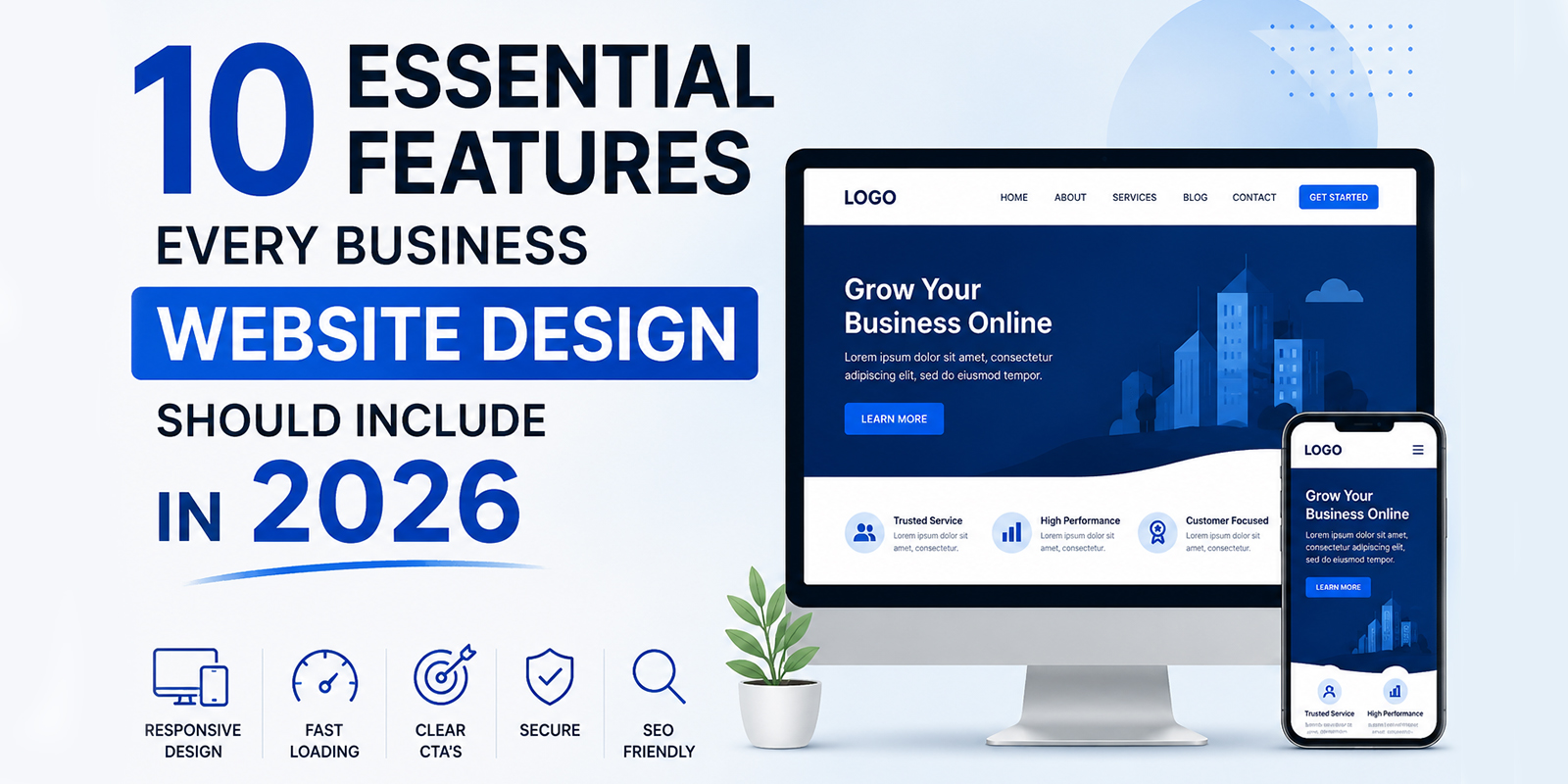
10 Essential Features Every Business Website Design Should Include in 2026

Introduction
Your website is often the first handshake between your business and a potential customer. Before anyone calls your office, visits your store, or fills out a contact form, they're going to judge you by your website — and they'll do it in about three seconds. In 2026, that judgment is shaped by faster expectations, smarter competitors, and a search landscape that has fundamentally shifted. Customers no longer find you through a single Google search box — they discover you across multiple search channels: traditional search engines, AI chatbots and answer engines, voice assistants, map and local listings, and social platforms doubling as search tools.
This is why search channel optimization has become inseparable from good website design. A site can no longer be built for Google alone; it has to be structured so it performs well across every channel where a potential customer might be searching. A website that looked "good enough" in 2020 can quietly cost you customers today. Visitors expect speed, clarity, and a seamless mobile experience. Search engines and AI tools expect structured, accessible content they can actually understand, index, and recommend across channels. And your brand needs a digital presence that builds trust in seconds, no matter which search channel brought the visitor to your door.
Whether you're redesigning an existing site or building one from scratch, here are the ten features no modern business website can afford to skip — each one playing a role in how well your site performs across search channels, not just on one platform.
Modern website design and Search Channel Optimization (SCO) go hand in hand. A well-designed website gives your business the technical foundation to appear not only in traditional search engines but also in AI-powered search, voice assistants, local search, social search, and other discovery platforms. Without a strong website, even the best SCO marketing strategy will struggle to deliver consistent visibility.
Feature #1: Clean, Modern & Brand-Focused Design
Clutter kills conversions. A modern website design uses whitespace intentionally, sticks to a consistent color palette and typography system, and reflects your brand's personality at every scroll. Visitors should be able to tell what your business does and what makes it different within seconds of landing on your homepage. Generic templates and stock visuals no longer cut it — your design needs to feel deliberately yours.
Feature #2: Mobile-First Responsive Design
More than half of global web traffic now comes from mobile devices, and that number keeps climbing. "Mobile-first" isn't just a buzzword — it means designing for the smallest screen first, then scaling up, rather than shrinking a desktop layout down. Buttons need to be thumb-friendly, text needs to be readable without zooming, and layouts need to reflow cleanly across phones, tablets, and desktops. A site that only "works" on desktop is a site that's losing half its audience.
Feature #3: Lightning-Fast Loading Speed
Speed is no longer a nice-to-have — it's a conversion and ranking factor. Studies have consistently shown that even a one-second delay in load time can significantly hurt conversions and bounce rates. In 2026, users expect sub-two-second load times, and Google's Core Web Vitals continue to reward sites that deliver them. Compressed images, modern hosting, lean code, and caching aren't optional technical details anymore — they're core business decisions.
Feature #4: Clear Calls-to-Action (CTAs)
A beautiful website that doesn't tell visitors what to do next is a missed opportunity. Every page should have a clear, visually distinct CTA — "Get a Free Quote," "Book a Consultation," "Start Your Trial" — placed where the eye naturally lands. Effective CTAs use action-oriented language, contrasting colors, and strategic placement above the fold and throughout the page, guiding visitors toward the action that matters most to your business goals.
Feature #5: Intuitive Navigation
If visitors can't find what they're looking for within a few clicks, they'll leave — and they won't come back. Intuitive navigation means a clean menu structure, logical page hierarchy, a visible search bar for larger sites, and breadcrumbs where appropriate. The goal is simple: any visitor, regardless of how they landed on your site, should be able to find your services, pricing, or contact information without friction.
Feature #6: High-Quality Visuals & Modern UI
Generic stock photography is easy to spot — and easy to distrust. Custom photography, thoughtful iconography, and subtle motion design (like scroll animations or micro-interactions) do far more to build credibility and engagement. Modern UI trends in 2026 lean toward tasteful minimalism: soft shadows, rounded elements, dark-mode options, and purposeful animation that enhances usability rather than distracting from it.
Feature #7: Lead Generation Forms & Live Chat
Your website should be working to generate leads even while you sleep. Strategically placed, short-form contact forms reduce friction for potential customers ready to reach out. Pairing this with live chat — increasingly powered by AI chatbots that can answer common questions instantly — captures visitors who might otherwise bounce without converting. The combination of "easy to ask" and "quick to respond" is what turns casual browsers into qualified leads.
Feature #8: Trust-Building Elements
People buy from businesses they trust, and trust has to be earned visually and instantly. Customer testimonials, case studies, client logos, certifications, security badges, and clear contact information all signal legitimacy. In 2026, transparency matters more than ever — visible privacy policies, real team photos, and authentic reviews (rather than curated-sounding quotes) go a long way toward reassuring skeptical visitors.
Feature #9: Accessibility & Inclusive Design
Accessibility isn't a legal checkbox anymore — it's good business. An accessible website (following WCAG guidelines) uses proper color contrast, alt text for images, keyboard navigation, and screen-reader-friendly markup. This ensures your site is usable by people with visual, motor, or cognitive impairments, but it also improves usability for everyone, boosts your SEO, and protects your business from accessibility-related legal risk, which continues to rise year over year.
Feature #10: SEO-Ready & AI-Ready Website Structure
Search has changed. It's no longer just about ranking on Google — it's about being discoverable and citable by AI-powered search tools, chatbots, and answer engines. That means clean semantic HTML, structured data (schema markup), fast technical performance, clear headings, and content written to directly answer real user questions. A site built for both traditional SEO and AI-driven discovery is a site future-proofed for how people will actually find businesses over the next several years.
Build a Business Website That Stands Out in 2026
A great business website in 2026 isn't just a digital brochure — it's a performance-driven asset that builds trust, generates leads, and works around the clock across every search channel your customers use. The businesses that win online this year will be the ones that treat their website as seriously as their storefront: fast, mobile-first, accessible, visually confident, and structured for both human visitors and the AI systems increasingly shaping how people discover businesses.
You don't need all ten features perfected on day one, but you do need a roadmap. Start with speed, mobile responsiveness, and clear CTAs — these have the most immediate impact on conversions. Then layer in trust elements, accessibility, and search channel optimization as you refine your site over time, making sure your content is structured to perform not just on Google, but on every channel where your customers are searching.
SCO (Search Channel Optimization) marketing is the practice of optimizing your business for every channel people use to search, including Google, AI search engines, voice assistants, local listings, social platforms, and marketplaces. Combined with a modern website, SCO marketing helps increase visibility, build trust, and generate more qualified leads from every digital touchpoint.