

Ninety-one percent of customer service and support leaders say they're under pressure from their own leadership to implement AI in 2026, according to a Gartner survey of 321 service leaders released in February 2026. That single number tells you this isn't a "someday" question anymore — it's a "what do we do this quarter" question, and sales teams are asking the same thing support teams already are.
But the honest answer isn't "replace your sales team with a chatbot," and it isn't "AI is a gimmick, stick with humans" either. The businesses getting real results in 2026 are the ones who've figured out exactly which parts of the sales process AI should own and which parts still need a person. This guide breaks that down — with real data, not hype.
What AI Chatbots Actually Do Well in Sales
Modern AI sales chatbots and agents aren't the scripted, keyword-matching bots of five years ago. Today's tools — running on large language models — can hold a genuine back-and-forth conversation, pull product or pricing information, qualify a lead against your criteria, and book a meeting, all without a human touching the conversation.
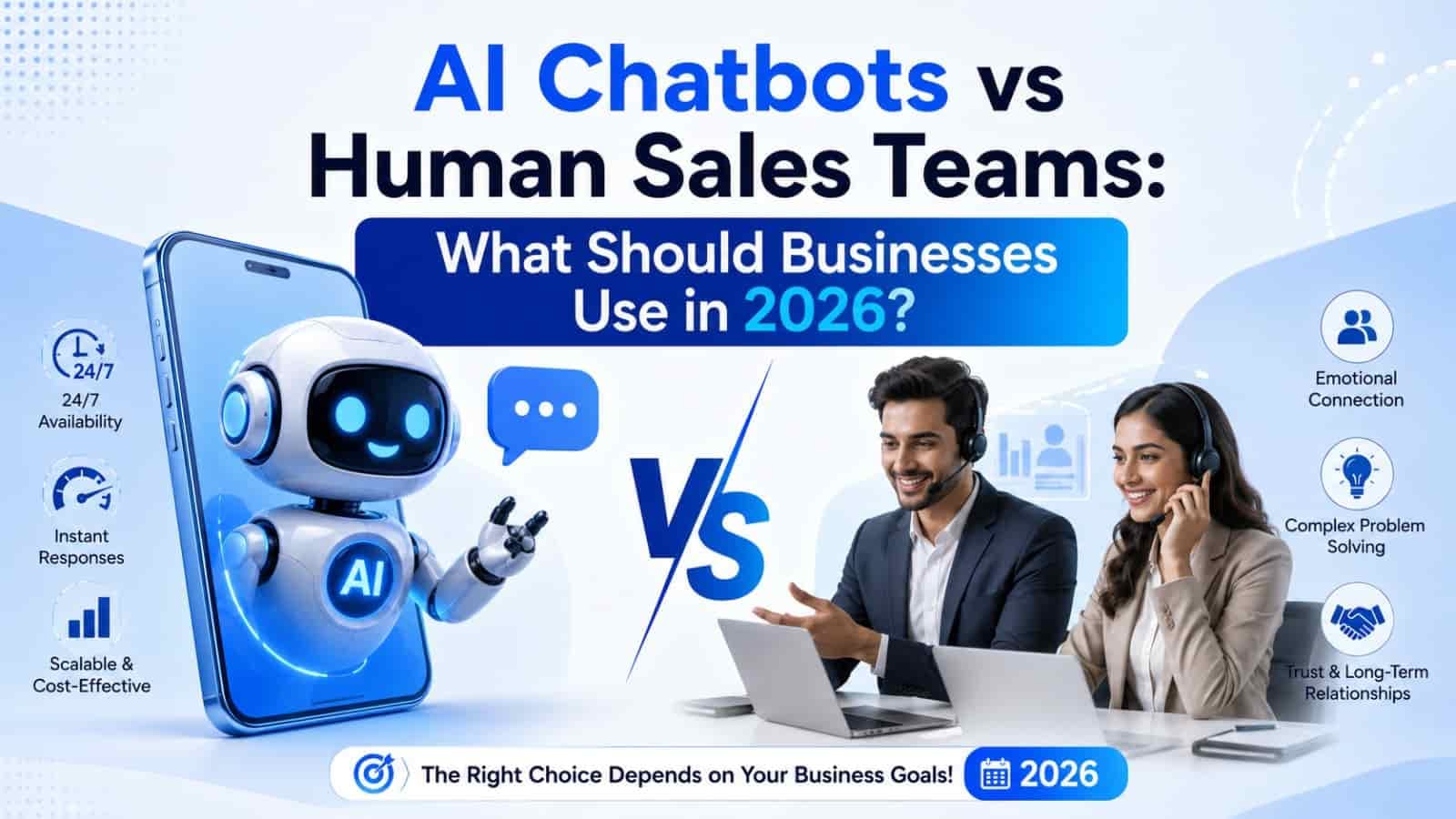
Instant, 24/7 first response. A chatbot never sleeps, never has a bad day, and never leaves a website visitor or WhatsApp message waiting. Industry data compiled by AI sales platforms shows chatbots deliver first responses roughly three times faster than typical human response times, and a majority of consumers say they'd rather get an instant AI answer to a simple question than wait for a person.
Lead qualification at scale. AI can ask the same qualifying questions to every single visitor — budget, timeline, use case — consistently, without getting tired or skipping steps because it's the end of a long day. Vendor-reported data puts chat-to-lead conversion rates anywhere from roughly 30% up to 70% depending on industry and implementation, though these figures vary a lot and should be treated as directional rather than guaranteed.
Consistent follow-up. AI doesn't forget to follow up, doesn't get distracted by a bigger deal, and can nurture hundreds of smaller leads simultaneously — work that would otherwise fall through the cracks of a busy human sales team's day.
What Human Sales Reps Still Do Better
Gartner's own framing of the 2026 shift is telling. As Kim Hedlin, Director of Research in Gartner's Customer Service & Support Practice, put it: service organizations are entering a period where "AI and human expertise must work in tandem" — leaders aren't just deploying AI, they're redesigning service models so technology handles routine work while humans provide context, empathy and judgment.
Complex, high-stakes negotiation. When a deal involves custom pricing, multiple stakeholders, or genuine back-and-forth negotiation, a skilled human closer still outperforms AI — reading tone, adjusting strategy mid-conversation, and building the kind of trust that gets a hesitant buyer to sign.
Relationship-driven and high-ticket sales. For real estate, enterprise B2B, financial services and other categories where the purchase is emotional, high-value, or long-cycle, buyers still want to talk to a person they trust before committing.
Reading the room. A frustrated or upset customer needs empathy, not a well-trained script. Humans still pick up on frustration, hesitation and unspoken objections in ways AI, even good AI, regularly misses.
What the Data Actually Shows
It's worth separating vendor marketing from independently verified research here — a lot of the eye-catching stats about AI sales chatbots come from the companies selling the tools, so treat single-source numbers with some caution. With that caveat:
Gartner's own research projects that agentic AI will autonomously resolve around 80% of common, routine customer service issues by 2029, cutting operational costs by roughly 30% — but explicitly frames this as "common" issues, implying complex and unusual cases will keep needing people well past that point. Separately, industry surveys report that a majority of B2B companies (over half) have already integrated some form of chatbot into their website, and online retailers are close behind, with most having implemented or planning to implement one.
The realistic takeaway: AI is genuinely good at volume and speed. Humans are genuinely better at judgment and trust. The gap between the two isn't closing to zero — it's just moving, with AI taking over more of the routine middle ground each year.
What It Costs to Build an AI Sales Agent in India (2026)
For Indian businesses evaluating this, cost is often the deciding factor. Rough industry figures for 2026 put a custom-built AI sales development (SDR) agent — the kind that researches leads and drafts personalised outreach — at roughly ₹3–8 lakhs as a one-time build cost, with ongoing monthly costs in the ₹20,000–50,000 range depending on volume and complexity.
For businesses that don't want to build custom, SaaS-based AI chat and sales-assist platforms typically run from a few thousand to around ₹50,000 a month depending on scale — a much lower barrier to entry than it was even two years ago, which is a big part of why adoption is accelerating across Indian SMEs, not just large enterprises.
The Hybrid Model Most Businesses Are Actually Building
Almost nobody serious is choosing "all AI" or "all human" in 2026. The pattern we see working across retail, real estate, education and B2B services is a layered handoff:
Stage 1 — AI handles first contact. Website chat, WhatsApp, and increasingly RCS messaging capture and respond to every inbound lead instantly, asking qualifying questions and answering common queries around the clock.
Stage 2 — AI qualifies and routes. Based on budget, intent and fit, the AI either keeps nurturing a low-priority lead automatically or immediately flags and hands off a qualified, high-value lead to a human rep — often syncing straight into the CRM so nothing gets lost.
Stage 3 — Humans close. The sales rep steps in already armed with the full conversation history and qualification data, so the first human interaction is a warm, informed one rather than a cold restart.
This is where messaging channel choice matters too — a business already sending order confirmations and offers over RCS or WhatsApp has a natural, high-trust channel for that AI-to-human handoff, rather than bolting on a separate chatbot widget nobody uses.
How to Decide What's Right for Your Business
Lean more AI if you have high lead volume, a short sales cycle, a lower average order value, and most questions are repetitive (pricing, availability, basic product info).
Lean more human if your average deal size is large, your sales cycle involves multiple stakeholders or custom negotiation, or trust and relationship are the actual reason customers buy from you over a competitor.
Start hybrid if you're unsure — deploy AI for first response and qualification only, keep every closing conversation human, and expand AI's role only as you see where it's genuinely saving time without hurting conversion.
Frequently Asked Questions
Will AI chatbots replace human sales teams entirely?
Not based on current data or expert projections. Even Gartner's most aggressive prediction — 80% of common issues resolved autonomously by 2029 — specifically limits that to routine, common cases, and frames the future as AI and humans working together rather than AI replacing sales teams outright.
Is an AI chatbot worth it for a small business?
Often yes, especially for capturing and qualifying leads outside business hours. SaaS-based tools have made this affordable even for small teams, and the main requirement is having a clear process for handing off qualified leads to a human quickly.
Which industries benefit most from AI-first sales interactions?
E-commerce, retail, education admissions, and other high-volume, lower-ticket categories tend to see the strongest results, since AI can handle repetitive questions at scale. High-ticket B2B, real estate and financial services still lean heavily on human relationship-building.
What's the biggest mistake businesses make when adopting AI for sales?
Deploying AI everywhere at once without a clear human handoff point. A chatbot that can't recognise when to bring in a person — and does so smoothly — frustrates customers faster than having no chatbot at all.
Building the Right Mix for Your Business
The real question in 2026 isn't AI chatbots versus human sales teams — it's how to route the right conversation to the right one. Getting that handoff right, across the channels your customers already use, is what separates businesses that get genuine efficiency gains from AI and ones that just add a frustrating extra step before reaching a human. If you're rethinking how leads move from first contact to close, it's worth looking at how you're capturing leads from your website, how you're using your CRM to convert leads into loyal clients, and whether channels like WhatsApp marketing or RCS business messaging are set up to make that AI-to-human handoff smooth rather than clunky.
Talk to our team about designing an AI-plus-human sales workflow that fits your business, your deal size, and your customers.