

Introduction
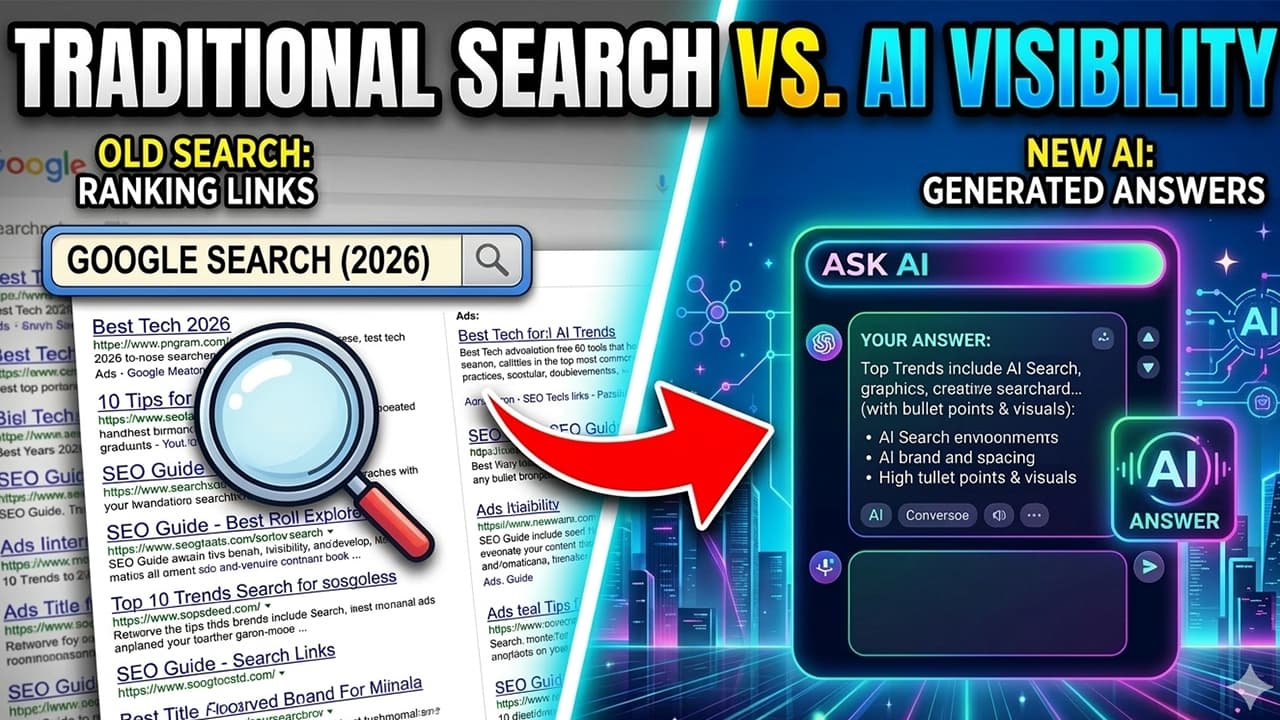
Search is no longer just about ranking pages on Google. In 2026, your content is competing for visibility inside AI systems that summarize, recommend, and sometimes replace traditional search results altogether.
This creates a real question for marketers and business owners: should you keep focusing on traditional SEO, or shift toward AI visibility? The answer is not either-or. It’s about understanding how both work and where the real leverage is now.
Traditional Search vs AI Visibility in 2026
Traditional Search
Traditional search is what most people still think of as SEO. You optimize pages for keywords, build backlinks, improve technical performance, and aim to rank on search engine results pages. Traffic comes when users click your link.
AI Visibility
AI visibility is different. Your content is not just ranked, it is used. AI tools scan, interpret, and pull information from your content to generate answers. Sometimes users never visit your site, but your content still influences what they see.
How Traditional SEO Still Works Today
Traditional SEO hasn’t disappeared. It still works, especially for high-intent queries. Ranking for commercial keywords, product searches, and local queries continues to drive traffic and revenue.
Strong fundamentals still matter:
Well-structured pages
Relevant keyword targeting
Backlinks and authority
Technical performance
But the growth curve has slowed. It’s harder to win with basic SEO tactics alone because competition is higher and search engines are smarter.
What AI Visibility Really Means
AI visibility is about becoming a trusted source of information, not just a ranked result.
Consistency of Expertise
Publishing random content doesn’t work anymore. AI systems favor websites that consistently demonstrate expertise in a specific topic.
Clarity of Explanation
Content that clearly explains concepts gets picked up more often. AI prefers simple, direct, and structured explanations over complex or vague writing.
Topic Ownership Signals
If your website deeply covers a subject with multiple connected pieces of content, AI starts to treat you as an authority in that space.
Why Keyword-First SEO Is Losing Impact
For years, SEO was driven by keywords. Find a keyword, create a page, optimize it, and rank. That model is weakening.
Search engines and AI systems now understand intent, context, and relationships between topics. Writing separate pages for every keyword variation leads to thin, repetitive content.
This is why many sites are seeing:
Stagnant traffic
Declining rankings
Lower engagement
It’s not that keywords don’t matter. They just aren’t enough on their own anymore.
How AI Evaluates Website Content
AI systems don’t just scan for keywords. They evaluate how useful, trustworthy, and complete your content is.
Depth Over Surface Keywords
A single detailed guide often performs better than multiple shallow posts targeting similar keywords.
Entity Clarity Over Thin Writing
AI looks for clear definitions, structured explanations, and well-connected ideas. Vague or filler content gets ignored.
Consistency Over Excessive Publishing
Publishing daily low-quality content doesn’t help. Consistent quality matters more than frequency.
Trust Signals Over Shortcuts
Backlinks still matter, but so do credibility signals like author expertise, citations, and factual accuracy.
What Still Compounds in Search Rankings
Even with all the changes, some things still build long-term SEO growth:
Strong domain authority
High-quality backlinks
Evergreen content
Internal linking
Topical depth
These are still worth investing in because they support both traditional rankings and AI visibility.
What Drives AI Visibility in 2026
AI visibility follows a different playbook.
Go Deep Rather Than Go Broad
Instead of covering many unrelated topics, focus deeply on a few core areas.
Clarity Over Cleverness
Simple, structured content performs better than creative but unclear writing.
Consistency Over Publishing Frequency
Publishing less content with higher quality creates stronger signals than posting frequently without depth.
Trust Over Tactics
There are no shortcuts here. AI systems reward credibility, not hacks.
The Biggest Mistakes Marketing Teams Make
Many teams are still operating with outdated strategies.
Common mistakes include:
Chasing too many keywords
Publishing high volumes of low-value content
Ignoring internal linking
Writing without clear structure
Treating AI content as a shortcut instead of a tool
These approaches lead to content that neither ranks well nor gets picked up by AI.
The Real Shift: From Ranking Pages to Explaining Topics
This is the biggest change happening right now.
Before:
Create pages to rank for keywords.
Now:
Build content systems that fully explain a topic.
Instead of asking, “How do I rank for this keyword?”
The better question is, “Have I covered this topic better than anyone else?”
This shift is what separates websites that grow from those that plateau.
Practical Strategy for 2026
Step 1: Choose Core Topic Areas
Pick 3–5 topics that align with your business. These should be areas where you want to build authority.
Step 2: Build Topic Clusters
Create a main pillar page for each topic, supported by detailed subtopics. Connect them through internal links.
Step 3: Focus on Explanation Quality
Write content that clearly answers questions. Use simple language, structured headings, and real examples.
Step 4: Strengthen Internal Linking
Help both users and AI understand how your content connects. This improves crawlability and authority flow.
Step 5: Publish Less, But Better
Instead of posting frequently, focus on depth and quality. One strong piece is better than five weak ones.
Conclusion
Traditional SEO is still important, but it’s no longer enough on its own. AI visibility is becoming a major factor in how users discover information.
The real advantage comes from combining both:
Use SEO to rank and attract traffic
Use high-quality content to influence AI systems
If you focus on depth, clarity, and trust, your content will perform across both worlds.
FAQs
What is the difference between traditional search and AI visibility?
Traditional search focuses on ranking pages in search engines, while AI visibility focuses on being referenced and used by AI systems to generate answers.
Is SEO still important in 2026?
Yes. SEO still drives traffic, especially for high-intent searches. However, it needs to be combined with content quality and topical authority.
Should you optimize for AI or search engines?
Both. Optimizing for users with clear, helpful content naturally supports both search rankings and AI visibility.
How do AI systems choose which websites to reference?
They prioritize content that is clear, accurate, well-structured, and consistently demonstrates expertise.
What type of content performs best for AI visibility?
In-depth, well-organized, and clearly written content that fully explains a topic.
Does publishing more content improve AI visibility?
No. Quality and depth matter more than quantity.
How can small businesses compete in AI-driven search?
By focusing on niche expertise and building strong topic clusters instead of trying to cover everything.
What is topical authority and why does it matter?
Topical authority means being recognized as a trusted source on a subject. It improves both rankings and AI visibility.
Can AI-generated content rank in search results?
Yes, but only if it is edited, accurate, and genuinely helpful.
What is the biggest SEO mistake in 2026?
Focusing on volume over value and ignoring the shift toward deep, topic-based content.