

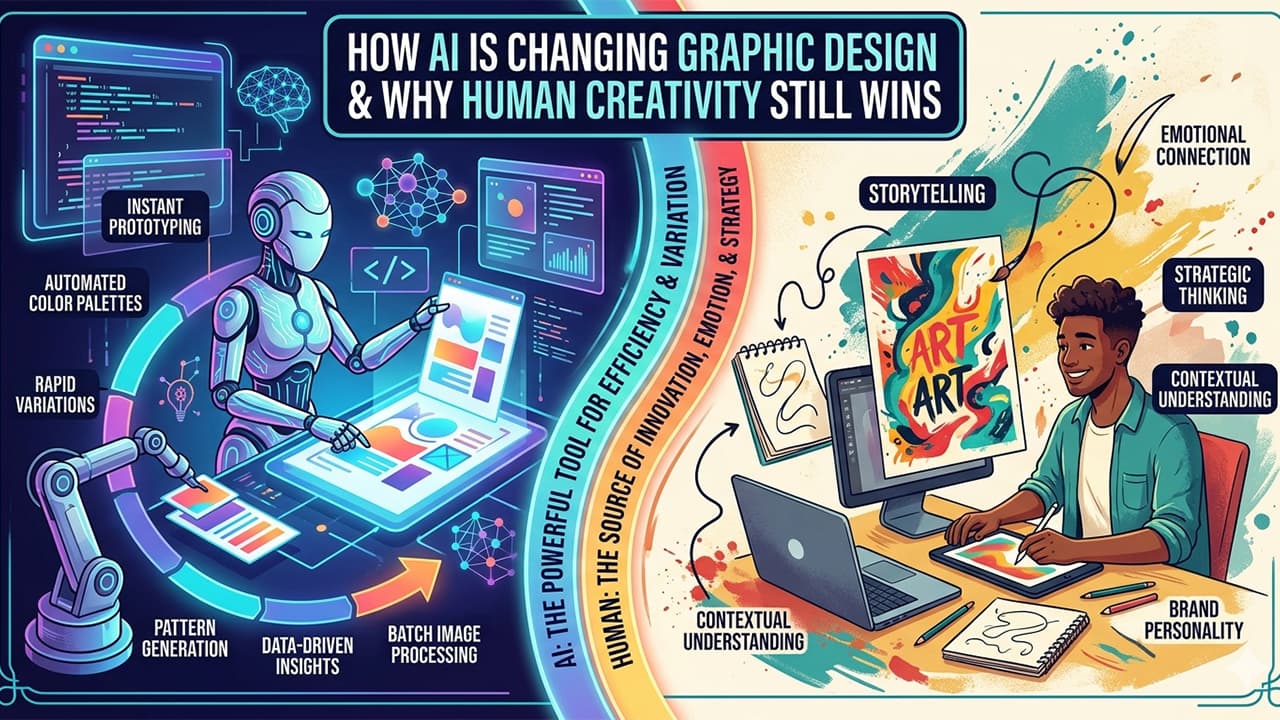
Artificial intelligence is no longer knocking at the door of the creative industry — it has walked in, pulled up a chair, and started rearranging the furniture. But does that mean the designer is out of a job? Far from it.
From generating brand logos in seconds to producing entire marketing campaigns with a single prompt, AI has fundamentally altered what it means to be a graphic designer in 2026. The tools are faster, cheaper, and increasingly capable. And yet, studios are hiring, design thinking is more valued than ever, and the creatives who understand how to work alongside AI are thriving. To understand why, we need to look honestly at both what AI can do — and what it cannot.
How AI is Changing Graphic Design
How AI is changing design
The most immediate impact of AI on graphic design has been speed. Tools like Midjourney, Adobe Firefly, and Stable Diffusion can produce polished visual concepts in the time it once took a designer to open a new Illustrator file. What used to require hours of ideation, sketching, and iteration can now be roughed out in minutes.
Beyond speed, AI has democratised access to design. Small businesses that could never afford a professional agency can now generate passable social media graphics, product mockups, or website layouts without any formal training. This is genuinely powerful — and it has shifted the baseline expectation of what "good enough" looks like at the entry level.
AI has also become a legitimate collaborator for professional designers. Using generative tools to explore visual directions, auto-generate background textures, or rapidly prototype layout options has become part of many studios' standard workflow. The designer's role is increasingly one of creative direction — shaping, refining, and contextualising what the machine produces.
The risks of using AI
Not everything about AI-powered design is a gain. There are real and growing risks that the industry is only beginning to reckon with.
The first is homogeneity. Because AI tools are trained on the same vast datasets, they tend to produce work that looks similar — competent, technically clean, but aesthetically predictable. The web is increasingly filled with images that feel like they belong to the same visual language, a kind of algorithmic sameness that erodes brand distinctiveness.
Copyright and ownership remain
deeply unresolved. Who owns an
image generated by a model
trained on unlicensed creative work? Legal frameworks are still catching up, and designers and clients both face exposure in using AI-generated assets commercially without fully understanding the implications.
There is also the risk of skill atrophy. If junior designers skip the foundational process of learning typography, colour theory, and composition by jumping straight to AI generation, the industry may produce a generation that can prompt but cannot truly design. The creative vocabulary required to direct and evaluate AI output well is built by doing the hard work first.
AI and design today
In practice, the most effective design studios in 2026 are running hybrid workflows. AI handles the generative grunt work — concept variations, asset production, background removal, image resizing — while human designers focus on strategy, brand narrative, client relationships, and the editorial decisions that give work meaning.
Platforms like Canva and Adobe Express have embedded AI so deeply into their products that non-designers use them daily, producing work at a quality level that would have been impossible without professional help five years ago. At the same time, premium branding, editorial design, packaging, and experiential work still commands significant investment — because clients understand that a logo is not just a shape, it is a representation of trust.
AI and the future of design
Looking ahead, AI will continue to reshape the economics of design. Volume-based work — social content, ad variants, templated materials — will increasingly be produced by machines. The market for "good enough, fast" will consolidate around AI-assisted self-service tools.
But the ceiling for what human-led design can achieve is rising too. As AI handles the tedious, designers have more cognitive bandwidth for the ambitious. The future belongs to creatives who use AI as a multiplier rather than a replacement — those who bring genuine vision, cultural intelligence, and emotional nuance to work that a model simply cannot replicate on its own.
Is Graphic Design Still Relevant in the Age of AI Tools?
Human creativity is impossible to replace
There is a version of this debate that frames AI and human creativity as competitors. That framing misunderstands what creativity actually is. Design is not just the production of images — it is the act of solving communication problems in ways that resonate with specific human beings in specific cultural moments. AI has no lived experience, no intuition about what a brand needs to say to earn trust, and no understanding of the feeling a client wants their customers to have when they open a package.
Great design is driven by empathy. It requires understanding the client's fear that their rebrand might alienate loyal customers, or the user's frustration with a navigation system that technically works but feels wrong. These are not problems that can be solved with a better prompt. They require conversation, curiosity, and the kind of lateral thinking that emerges from a life spent observing the world.
Originality, too, remains a fundamentally human quality. AI produces variations on what already exists. The most memorable design work — the campaigns that enter culture, the identities that define generations — comes from designers willing to make choices that are unexpected, risky, and occasionally wrong. Machines optimise for the plausible. Humans reach for the extraordinary.
Value real world designers are bringing in 2026
In concrete terms, here is what separates strong human designers from AI output in today's market: strategic thinking. A designer who can sit with a client, understand their competitive landscape, identify what makes them genuinely different, and translate that into a coherent visual identity is offering something irreplaceable. AI cannot conduct a discovery workshop. It cannot challenge a client's brief when the brief is wrong.
Designers in 2026 are also bringing craft knowledge that informs better AI direction. Knowing why a particular typeface creates tension with a certain colour palette, or why a layout breaks spatial harmony, allows a designer to use generative tools purposefully rather than accepting whatever the model produces. The output of AI in the hands of a trained designer is meaningfully different from the output in the hands of someone who has never held a pencil.
Client relationships remain another domain of irreducible human value. Trust is built through communication, accountability, and the reassurance that a real person is responsible for the outcome. For high-stakes work — rebranding a company, designing a campaign for a sensitive product, building a visual identity that has to last a decade — clients are not looking for the cheapest option. They are looking for the right partner.
Conclusion
AI has changed graphic design irrevocably, and anyone who pretends otherwise is not paying attention. The tools are powerful, accessible, and only getting better. But the discipline of design has always been about more than making things look good — it is about communicating clearly, building trust, and creating work that moves people. Those things require a human being.
The designers who will thrive are not those who resist AI, nor those who outsource their thinking to it. They are the ones who treat it as what it is: a remarkably capable tool in the hands of someone who still knows what they are doing, and why.