

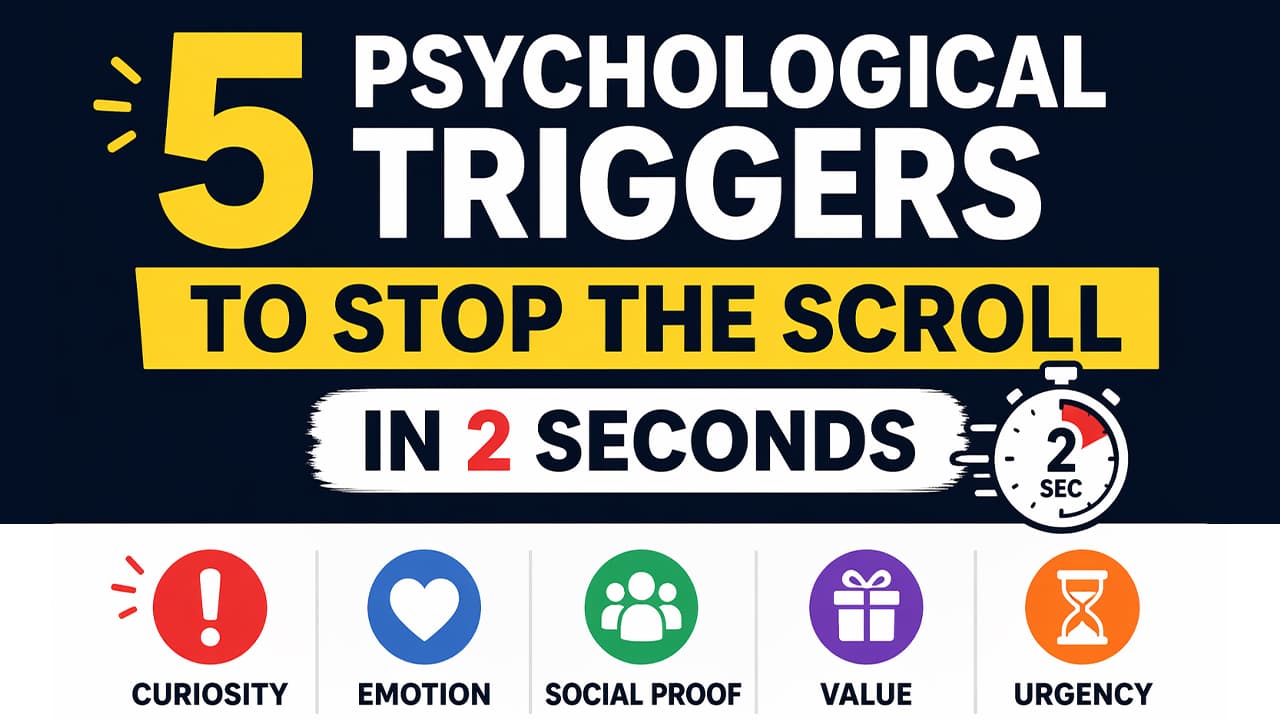
You have two seconds. That's the average window before a thumb flicks past your post, your ad, your content — erasing hours of work in less time than it takes to blink twice. The feed is a river, and most content drowns quietly without anyone noticing it was there.
But some content stops people dead in their tracks. Not by accident. There's a science to it — a set of psychological triggers that short-circuit the scroll reflex and force the brain to pause. Understanding these triggers is the difference between content that performs and content that vanishes.
This guide breaks down the five most powerful hook triggers, how they work in the brain, and exactly how to use them in your content — whether you're writing captions, headlines, or video openers.
Why the 2-second hook rule matters
The average person sees between 6,000 and 10,000 pieces of content every single day. Social platforms are engineered to be infinite — the feed never ends, and the next dopamine hit is always one swipe away. Your content is competing not just with other brands, but with friends, news, memes, and a decade of perfectly optimised algorithmic content.
The first two seconds of any piece of content determine whether the rest gets consumed at all. No hook means no retention, no engagement, and no conversion — no matter how good the rest of the content is.
The psychology behind scroll-stopping content
Scrolling is largely an unconscious, automatic behaviour — it's a habit loop. The brain is always scanning for novelty, relevance, or reward. A great hook does one of three things: it surprises the brain out of autopilot, promises a reward worth pausing for, or triggers an emotional response that overrides the scroll reflex. The five triggers below each do one or more of these things.
Trigger 01
Pattern interruption – break the scroll habit
The brain is a prediction machine. It scrolls on autopilot because it expects the same familiar format: branded header, stock photo, caption. Pattern interruption works by violating that expectation — delivering something so unexpected that the brain is forced to stop and re-evaluate what it's seeing.
This can be a visual (an unusual angle, a colour that doesn't belong), a sentence structure that breaks mid-thought, an unexpected statistic, or a provocative opinion the audience didn't see coming. The key is genuine surprise — not just noise.
Example hook
"We deleted our entire Instagram strategy. Here's what happened next."
Trigger 02
Curiosity gap – create the 'wait, what?' moment
The curiosity gap is the distance between what someone knows and what they want to know. When information is deliberately incomplete, the brain experiences a mild discomfort — an itch that needs scratching. The only way to scratch it is to keep reading.
The formula is simple: hint at something interesting without giving away the answer. Tease the destination without revealing the route. Done well, the curiosity gap makes scrolling past feel almost physically uncomfortable.
Example hook
"Most brands make this one mistake in their first post — and it costs them everything."
Trigger 03
Instant value promise – show the benefit fast
Some people don't need to be tricked or teased — they just need to know the content is worth their time. The instant value promise is a direct, concrete statement of what the audience will gain by reading, watching, or listening. No mystery, no games. Just a clear exchange: "give me 60 seconds, and I'll give you X."
This trigger works especially well for tutorial content, tips, and listicles. The specificity of the promise matters enormously — "5 ways to write better hooks" outperforms "how to write better content" every time.
Example hook
"3 subject line formulas that increased our email open rate by 47% in 30 days."
Trigger 04
Emotional resonance – make them feel something
Emotion is the fastest route to attention. When content triggers an emotional response — whether it's empathy, outrage, nostalgia, fear, or delight — the brain tags it as important and pulls focus toward it automatically. This is a survival mechanism; emotionally charged stimuli get prioritised.
The most effective emotional hooks don't manufacture feelings — they name a feeling the audience already has. A hook that says "you already know this feeling" creates an instant sense of being seen and understood, which is one of the most powerful drivers of engagement.
Example hook
"You've spent hours on content that got 12 likes. That feeling never gets easier to ignore."
Trigger 05
Social proof – if others care, I should too
Humans are deeply social animals. When we see evidence that other people found something valuable — whether that's a number, a testimonial, or a reference to widespread behaviour — our brain interprets it as a signal of quality. This is the social proof heuristic, and it's one of the most consistent persuasion mechanisms in psychology.
In a hook, social proof can appear as a striking statistic, a reference to how many people have engaged with an idea, or a quote that implies consensus. It answers the unconscious question: "should I care about this?" with "yes — everyone else does."
Example hook
"Over 40,000 marketers downloaded this one-page content framework last month."
How to stack triggers for better hooks
The most powerful hooks don't rely on a single trigger — they layer two or three together for compounding effect. Stacking works because each trigger addresses a different psychological mechanism simultaneously, making it much harder for the brain to scroll past.
Pattern interrupt + curiosity gapBreak expectations, then leave a question unanswered. The audience is disoriented and needs resolution.
Social proof + instant valueProve others benefited, then make an explicit promise. High credibility, low friction.
Emotional resonance + curiosity gapName a feeling, then hint at a solution. Creates urgency without being pushy.
Pattern interrupt + instant valueSurprise them, then immediately justify the interruption with a clear payoff.
Common hook mistakes to avoid
✕
Opening with "I" or "We" — the audience doesn't care about you yet. Lead with them or lead with the idea.
✕
Vague curiosity gaps — "You won't believe this!" is not a curiosity gap. It's noise. Be specific about what's being withheld.
✕
Burying the hook — the hook is the first sentence, not the third. The audience won't reach your second paragraph to find it.
✕
Clickbait without payoff — a hook that over-promises destroys trust permanently. The content must deliver what the hook implies.
✓
Test relentlessly — even a 10% change in hook wording can double engagement. Treat every hook as a hypothesis, not a finished product.
Why brands struggle with hooks
Most brands write hooks from a brand-first perspective: "let me tell you about us, our product, our value proposition." But the audience is operating from a completely different frame: "what's in it for me, and is this worth my next 30 seconds?"
The gap between those two perspectives is where most content fails. Brands also tend to default to safe, polished language — which, paradoxically, is exactly what the brain's pattern-matching system ignores most efficiently. Safe content sounds like every other piece of content, so the brain treats it like noise and scrolls past without registering it.
The fix is a mindset shift: write hooks as if you are the audience encountering your content cold, with no prior context and no loyalty. Ask "would I stop?" before publishing anything.
Conclusion
Stopping the scroll isn't luck, and it isn't magic. It's applied psychology — a deliberate choice to trigger one or more of the five mechanisms that override the brain's autopilot and demand attention. Pattern interruption breaks the habit. The curiosity gap creates an itch. The value promise justifies the pause. Emotional resonance makes the content feel personal. Social proof signals that the pause is worth it.
The two-second window is not a problem to complain about — it's a constraint to design around. Every piece of content you publish deserves a hook that earns its audience. Because the best content in the world is worthless if nobody gets past the first line.
Start with one trigger. Test it against your current approach. Then layer. The difference between content that performs and content that disappears is often a single, well-placed sentence at the very top.